
13 min read 8 clicks
Transarterial chemoperfusion (TACP), also called intra-arterial chemotherapy, delivers chemotherapy through a thin tube (catheter) straight into the arteries that feed a tumour, without blocking those vessels. This regional approach aims to control the tumour while limiting the side effects of chemotherapy elsewhere in the body. It differs from transarterial chemoembolisation (TACE), which also blocks the vessels [1].
For men considering treatment in Germany, TACP for prostate cancer is not a routine option. It has been reported in only a few carefully selected men, mainly to treat problems caused by the tumour in the pelvis. Specialists decide case by case, looking at the pattern and extent of the disease, earlier treatment, scans, artery anatomy and general health.
TACP Treatment Selection for Prostate Cancer
Published reports describe three quite different situations in which TACP or a closely related technique was used in men with prostate cancer [2] [3] [4] [5].
| Clinical situation | Why TACP or a related technique was discussed | Main limitation |
|---|---|---|
| Recurrent pelvic tumour after earlier treatment | Regional chemotherapy for a pelvic tumour that returned after earlier treatment | Only one man with prostate cancer, in a German pelvic series |
| Advanced disease with urinary obstruction or bleeding | Chemoembolisation with epirubicin beads was used to relieve urinary symptoms in men with advanced disease | Uncontrolled case series, embolisation included, hormone therapy given alongside in one series |
| Localised disease in a research setting | Chemoembolisation with docetaxel was studied in men with localised disease | 20 men, one centre, not a replacement for surgery or radiotherapy |
The table above shows when TACP or a related technique has been reported, why it was used and the main limit of each report.
Because the evidence comes only from small case series, the decision is made case by case by a multidisciplinary team.
Before any decision, the team usually reviews the following:
- Stage, extent and earlier treatment, including surgery, radiotherapy and hormone therapy.
- The trend in prostate-specific antigen (PSA) levels and imaging such as MRI, CT or prostate-specific membrane antigen (PSMA) PET.
- Whether the tumour can be reached through its blood supply, judged on CT or MR angiography.
- Kidney function, because contrast dye is used, and any contrast allergy.
- Bleeding risk, including blood-thinning medicines, and fitness for a catheter procedure.
- The patient’s goals and whether a standard treatment or a clinical trial is still available.
The Role of TACP in Prostate Cancer Treatment

TACP can offer a regional, palliative option for selected men whose tumour has come back in the pelvis, as proposed by the authors of a German pelvic series. Standard prostate cancer treatment, including surgery, radiotherapy, androgen deprivation therapy and systemic drugs chosen by stage, is set out in the German S3 guideline, and TACP is not part of it [2] [6].
Three related techniques are often confused. TACP infuses chemotherapy into the arteries that feed the tumour and leaves them open. TACE adds oil or tiny particles that also cut off the blood flow, and prostatic artery chemoembolisation uses particles that carry the drug into the prostate arteries [1] [5].
Being reachable by catheter does not mean a tumour will respond, and TACP does not replace standard options such as systemic chemotherapy. A specialist review of your records can show which options remain open before you plan travel to Germany.
TACP Procedure and Follow-Up for Prostate Cancer
| Step | Stage |
|---|---|
| 1 | Specialist assessment |
| 2 | CT or MR angiography |
| 3 | Catheter access |
| 4 | Artery mapping |
| 5 | Chemotherapy infusion |
| 6 | Recovery monitoring |
| 7 | Follow-up imaging and PSA |
The table above shows the main steps from specialist assessment to follow-up.
Protocols differ between centres, and the steps below follow how TACP has been described in published pelvic series rather than a prostate-specific protocol [1] [2]:
- Blood tests, including kidney function, are checked and the scans are reviewed.
- After a local anaesthetic, a thin catheter is passed through an artery in the groin under X-ray guidance.
- Contrast dye shows which vessels feed the tumour and whether nearby organs share them.
- Chemotherapy is infused slowly into the feeding arteries, using drugs and doses chosen by the treating team.
- The catheter is removed, the puncture is closed and the patient is observed for several hours, often with a CT scan to check for complications.
Follow-up usually combines a review of symptoms, PSA measurement and MRI or CT to judge the response. Pelvic TACP is usually given as a course of repeated sessions, but no schedule has been established for prostate cancer, and how many are given depends on the individual’s condition.
TACP Side Effects and Procedure Risks in Prostate Cancer

In the German pelvic series, TACP caused no severe (grade III or IV) toxicity, and patients were treated as outpatients. Side effects can still come from the catheter procedure and from the chemotherapy, and safety data for prostate cancer come from very few men, so uncommon problems may be missed [2].
Risks of the Arterial Procedure
Any catheter procedure carries risks, which the team discusses beforehand:
- Bleeding or bruising at the puncture site, and injury to the artery.
- Reaction to contrast dye, or strain on the kidneys.
- Chemotherapy reaching nearby tissue through shared vessels.
The prostate studies used embolisation, which TACP does not, so their complications may not apply directly. One series reported reduced blood supply (ischaemia) of the bladder wall that needed surgery in one man, urinary retention and urinary urgency in one man each, and sexual problems in two men that fully resolved. Another saw a small ischaemic area at the urethral opening that healed within 2 weeks and rectal wall ischaemia on MRI without clinical consequences [3] [5].
After the procedure, tell the treating team without delay about bleeding where the catheter entered, a pale or cold leg, fever, new or worsening pelvic pain, blood in the urine or difficulty passing urine.
Chemotherapy-Related Side Effects
Regional delivery aims to limit exposure elsewhere in the body, but some of the drug still reaches the bloodstream.
Possible effects depend on the drug and dose, and common ones include the following [7]:
- Lower blood counts, raising the risk of infection and anaemia.
- Nausea, vomiting and loss of appetite.
- Fatigue.
- Mouth sores and inflammation.
- Hair loss with some drugs.
Blood counts and kidney function are usually checked around each session.
TACP Results and Evidence in Prostate Cancer
Evidence for transarterial chemoperfusion in prostate cancer is very limited, and most reports describe related techniques that also block the arteries. For this reason, TACP is not part of standard treatment for prostate cancer.
| Report | Technique used | Men with prostate cancer treated |
|---|---|---|
| German pelvic series | TACP (no embolisation) | 1 |
| Pisco et al. | Chemoembolisation | 20 |
| Guan et al. | Chemoembolisation | 8 |
| Wang et al. | Chemoembolisation | 32 |
The table above shows how few men with prostate cancer appear in these reports and that only one had TACP without embolisation.
The main findings of the four reports are summarised below [2] [3] [4] [5]:
- A German series of 24 patients with tumours that had returned in the pelvis included one man with prostate cancer. The authors saw TACP as a palliative option.
- In 20 men with localised disease, chemoembolisation with docetaxel kept PSA lower for 12 to 18 months in more than half of the men whose prostate arteries were treated on both sides, and about one in three had side effects.
- In 12 men with advanced disease and urinary blockage, chemoembolisation with epirubicin beads was followed by lower PSA and a smaller prostate. All the men also started hormone therapy within days, so these changes cannot be credited to chemoembolisation alone.
- In 32 men with bleeding that had not responded to other treatment, chemoembolisation with docetaxel stopped the bleeding within days, and most still had good bleeding control about two years later.
These reports cannot show that TACP controls prostate cancer or extends life, because small uncontrolled series cannot separate the effect of treatment from patient selection. Most of them also included embolisation, so their results cannot be transferred directly to TACP.
Results from other cancers do not carry over. Findings from a 2024 series of women with gynaecological tumours treated with TACP or TACE cannot be applied to prostate cancer, because the tumours differ in biology and treatment context [1].
TACP Treatment in Germany and Specialist Assessment
In Germany, the first step is a specialist review of the records and images described above, followed by a discussion of whether TACP is worth considering. The associated specialist for TACP is Prof. Dr. Thomas Vogl at University Hospital Frankfurt am Main.
Availability and Preparation for International Patients
Availability differs between centres and should be confirmed before travelling, because TACP for prostate cancer is offered only in selected cases.
To prepare for a first assessment, international patients can gather the following:
- Pathology reports, including the grade.
- Recent MRI, CT or PSMA PET images, not only the written reports.
- A full treatment history.
- PSA values over time and recent kidney function results.
Useful questions for the specialist include the following:
- Does my pattern of disease match what has been reported for TACP?
- Which other options do I still have, including clinical trials?
- Does your centre offer TACP, and what would the risks be in my case?
The cost depends on the number of sessions, imaging, anaesthesia, drugs, hospital stay and follow-up, so no fixed price can be given. International patients can ask the German centre for a written cost estimate before travelling.
TIG GmbH (Treatment in Germany) can review medical records and imaging and identify German specialists or centres for assessment. Through its Online Consultation service, TIG can arrange a first discussion with a German specialist before travel, and its Germany Visa Invitation Service helps with the invitation letter for a medical visa. A review does not guarantee eligibility or benefit, and the German medical team decides on suitability and treatment. Patients can contact TIG to ask which documents to send first.
References
Why Patients Worldwide Prefer Our Medical Services in Germany – Key Benefits Explained
International patients planning TACP treatment for prostate cancer in Germany may need support with hospital consultations, medical documentation, medical translation services, and travel arrangements. TIG GmbH helps coordinate these practical steps and communication with healthcare providers according to each patient's needs and the services agreed.
If you are unsure about a diagnosis or the recommended plan, a second opinion from German specialists can also be arranged based on your medical records.
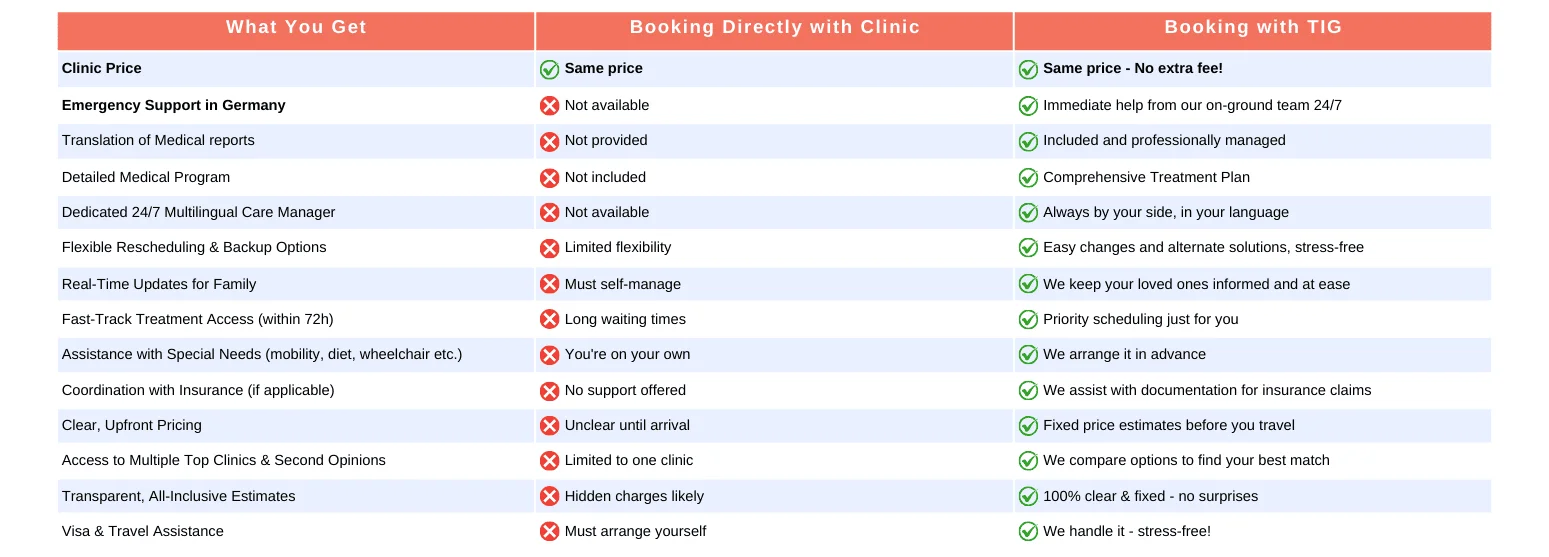
The table above compares the support and coordination services offered through TIG GmbH for TACP treatment for prostate cancer in Germany with the arrangements patients may need to manage when booking directly with a clinic.

Frequently Asked Questions About TACP for Prostate Cancer
Who Performs TACP for Prostate Cancer?
TACP is performed by interventional radiologists, doctors who treat through blood vessels under imaging guidance. The decision to use it is usually made together with urologists, oncologists and radiation oncologists in a multidisciplinary tumour board, which weighs TACP against standard options for the individual patient.
How Is TACP Different From Standard Chemotherapy?
Standard chemotherapy, such as docetaxel, travels through the whole body and is an established treatment for advanced prostate cancer. TACP sends the drug only into the arteries of one area, so it can treat a problem in the pelvis but not cancer elsewhere. It is not a substitute for whole-body treatment, and the two may be used at different points in care.
How Does TACP Differ From Prostate Artery Embolisation (PAE)?
PAE blocks the arteries supplying the prostate with tiny particles and is mainly used for urinary symptoms of an enlarged prostate. TACP infuses chemotherapy and keeps the arteries open. In prostate cancer, both have been studied only in small series, mainly to relieve urinary symptoms or bleeding and, in a few men with localised disease, to treat the cancer itself without proof of lasting benefit.
Will TACP Cure Prostate Cancer?
No. TACP is not a cure. In the published reports, it was used to relieve symptoms such as bleeding or urinary blockage, or to treat a recurrent pelvic tumour, alongside or after standard treatment. Its realistic aim is to ease local problems in the pelvis.
Will I Continue Hormone Therapy During TACP?
Most men with advanced prostate cancer stay on hormone therapy that keeps testosterone low, and TACP is given alongside it rather than instead of it. Hormone tablets or injections usually continue as planned. The treating team decides whether any medicine, such as a blood thinner, needs to pause or change around each session.
How Does TACP Help When Prostate Cancer Has Spread?
TACP treats only the area supplied by the treated arteries, so it cannot control cancer that has spread throughout the body. Medicines that act on the whole body remain the basis of treatment for spread prostate cancer. TACP may still be considered when a problem in the pelvis, such as bleeding, needs local treatment.
What Kind of Anaesthesia Is Used for TACP?
TACP is usually done under local anaesthesia at the groin, where the catheter enters, so patients stay awake. They lie still during the infusion and are observed for several hours afterwards while the puncture site settles. The centre explains how long patients need to stay before going home.
What Happens If TACP Does Not Help?
If scans or symptoms show no benefit, the team stops TACP and reviews other options, such as systemic treatment, radiotherapy, radioligand therapy or a clinical trial, depending on earlier treatment and general health. Stopping early avoids side effects from a treatment that is not working.
.webp)





.webp)





 (1).webp)
 (1).webp)

.webp)
.webp)