
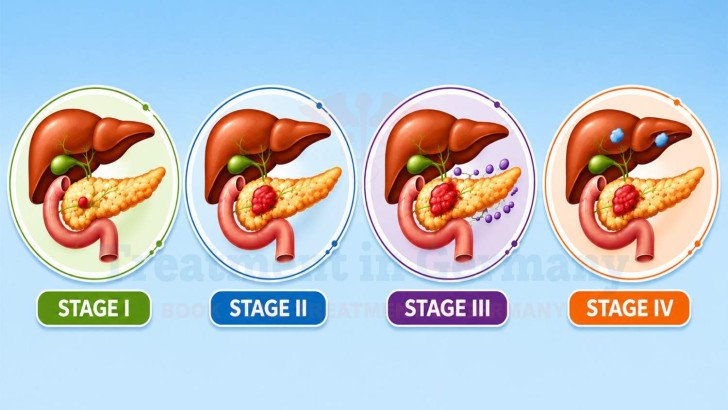
Pancreatic cancer is classified using the TNM system, which describes the primary tumour, lymph-node involvement, and distant spread to determine Stages 1 to 4. This article also explains resectability as a separate but related assessment based on the tumour’s relationship with nearby major blood vessels, helping distinguish resectable, borderline resectable, and locally advanced or unresectable disease and supporting clinical decision-making.
Pancreatic Cancer Staging and Resectability
Two related classifications describe the extent of pancreatic cancer and whether complete surgical removal may be technically feasible. Staging sets out the anatomical extent of the disease, while resectability assesses whether surgery is technically feasible, and the two do not always line up. Understanding the TNM system, how it defines Stages 1 to 4, and the separate resectability categories helps clarify how the disease is classified and assessed for treatment planning [2].
Pancreatic Cancer Staging and TNM Classification

Staging classifies a cancer by the extent of disease, not by symptoms or how it will be treated. The standard framework is the TNM system, which grades three features and combines them into an overall stage [1]:
- T describes the extent of the primary tumour, mainly according to its size and, in T4 disease, involvement of specific major arteries.
- N describes regional lymph nodes and how many contain cancer.
- M describes distant metastasis, meaning spread to organs beyond the pancreas.
These three categories translate into a Stage 1 to 4 grouping that summarises the whole picture at a glance. Anatomic stage and resectability are related but distinct, since a tumour can sit at a low stage yet still be hard to remove because of where it lies. Conventional Stage 1 to 4 staging applies to pancreatic ductal adenocarcinoma; pancreatic neuroendocrine tumours follow separate staging rules. NCI provides separate AJCC-based staging tables for exocrine pancreatic cancer and pancreatic neuroendocrine tumors. Throughout, staging speaks only to how far the disease reaches [1].
Primary Tumor and T Categories
The T category is set mainly by tumour size, with a separate rule for arterial involvement [1]:
- T1: 2 cm or smaller.
- T2: larger than 2 cm and up to 4 cm.
- T3: larger than 4 cm.
- T4: a tumour of any size involving the celiac axis, superior mesenteric artery, or common hepatic artery.
Size determines the T1 to T3 categories, while T4 is defined by involvement of specific major arteries rather than tumour size. This represents local tumour involvement of nearby major arteries and is different from distant spread to other organs.
Regional Lymph Nodes and N Categories
The N category counts how many nearby lymph nodes contain cancer, based on the AJCC 8th-edition framework [1]:
- N0: no regional lymph nodes involved.
- N1: one to three involved regional nodes.
- N2: four or more involved regional nodes.
The number of positive nodes feeds directly into the overall stage, so more involved nodes push the stage higher with N2 disease generally resulting in a higher stage group than otherwise comparable N0 or N1 disease. Regional node involvement is not the same as distant metastasis; these nodes sit near the pancreas, so cancer in them still counts as local-regional disease rather than Stage 4.
Distant Metastasis and M Categories
The M category records whether pancreatic cancer has spread to distant sites:
- M0: no distant metastasis.
- M1: distant metastasis is present.
Distant metastatic disease means cancer has reached organs away from the pancreas, most often the liver, the lining of the abdomen, or the lungs. Any M1 finding places the cancer at Stage 4, regardless of the T or N category. This distinction separates local or regional disease from distant metastatic disease.
Pancreatic Cancer Stages 1 to 4
The stage groups gather the TNM categories into a single label that describes overall disease extent [1].

How the TNM categories combine into stages, based on the AJCC 8th-edition framework.
Stage 1 Pancreatic Cancer
Stage 1 pancreatic cancer is confined to the pancreas, with no regional lymph-node involvement or distant metastasis. Stage 1A includes tumours measuring 2 cm or smaller, while Stage 1B includes tumours larger than 2 cm and up to 4 cm.

Stage 2 Pancreatic Cancer
Stage 2 includes either a larger primary tumour without regional lymph-node involvement or a tumour associated with limited regional lymph-node involvement provided there is no distant metastasis:

Stage 2A includes tumours larger than 4 cm without regional lymph-node involvement. Stage 2B includes T1 to T3 tumours with involvement of one to three regional lymph nodes. Compared with Stage 1, Stage 2 involves either a larger primary tumour or limited regional lymph-node involvement, but there is still no distant metastasis.
Stage 3 Pancreatic Cancer
Stage 3 describes extensive local or regional disease without distant metastasis. It may overlap with what clinicians describe as locally advanced pancreatic cancer, particularly when major blood vessels are involved, but TNM stage and resectability remain separate classifications [1].

Stage 3 may involve a tumour affecting major arteries or cancer involving four or more regional lymph nodes. In both situations, there is no distant metastasis, so the disease remains M0. Depending on the reason for the Stage 3 classification and the tumour's relationship with nearby blood vessels, resectability may vary from one patient to another. Importantly, Stage 3 does not mean the cancer has spread to distant organs; distant metastasis is what defines Stage 4 [2].
Stage 4 Pancreatic Cancer
Stage 4 pancreatic cancer is defined by distant metastasis or M1 disease, regardless of the size of the primary tumour or the extent of regional lymph-node involvement. Common sites of distant spread include the liver, the lining of the abdomen, and the lungs. A large or locally invasive tumour without distant metastasis is not classified as Stage 4 solely because of its size or involvement of nearby structures.

Pancreatic Cancer Resectability Categories

For nonmetastatic pancreatic ductal adenocarcinoma, treatment-planning categories usually include, borderline resectable, or locally advanced or unresectable. These categories are based largely on the tumour's relationship with nearby major blood vessels and other critical structures and help determine whether complete surgical removal may be technically feasible [2].
Distant metastatic disease changes the surgical assessment because the cancer has spread beyond the local pancreatic region. For this reason, resectability categories used for localized pancreatic cancer do not describe the full extent of metastatic disease. Resectability assessment is particularly important in pancreatic cancer because the tumour's relationship with nearby major blood vessels can strongly influence whether complete surgical removal is technically feasible. Exact criteria differ between contemporary guidelines so the same tumor may be assigned a different resectability category depending on the criteria being applied [2][3].
Resectable Pancreatic Cancer
Resectable pancreatic cancer is localized disease without involvement of nearby structures that would prevent complete surgical removal. Resectability is determined primarily by the tumour's anatomical relationship with major blood vessels rather than by the TNM stage number alone. Even a localized tumour may require detailed imaging and specialist review to determine whether surgery is technically feasible [2].
Borderline Resectable Pancreatic Cancer
Borderline resectable disease is the intermediate category, with limited involvement of certain nearby major vessels or other anatomic features that make an R0 resection uncertain or technically more difficult but can still allow surgical resection, often after preoperative therapy. In commonly used anatomical classification systems, limited contact with certain major arteries, often described as 180 degrees or less, or selected involvement of veins that may be reconstructable, can support a borderline resectable classification. It lies between clearly resectable and unresectable disease. Because the exact criteria can vary between classification systems, multidisciplinary assessment is important when determining the appropriate category. Some frameworks also weigh factors such as findings suspicious for occult metastatic or nodal disease, in addition to anatomic criteria when characterizing borderline-resectable when defining this category [2] [3] [4].
Locally Advanced and Unresectable Pancreatic Cancer
Locally advanced pancreatic cancer describes extensive local disease that prevents straightforward complete removal, usually because the tumour surrounds a major artery beyond about 180 degrees or otherwise involves vessels that cannot be safely reconstructed. Such a tumour may be considered unresectable when complete surgical removal is not considered technically feasible because of its involvement with critical nearby structures [2].
Locally unresectable disease can remain confined to the pancreatic region and remain non metastatic and therefore remain M0, while metastatic disease has spread to distant organs and is classified as M1 or Stage 4. For this reason, unresectable pancreatic cancer does not automatically mean Stage 4.
People often use the everyday term inoperable pancreatic cancer, but it is less precise than the formal resectability categories, because it blurs the line between a tumour that cannot be removed for local anatomical reasons and one that has spread. Locally advanced disease may remain M0 despite being unresectable, which is why formal staging and resectability terms provide a clearer description than the general term “inoperable.”
Clinical Assessment of Pancreatic Cancer Stage and Resectability

Assessing pancreatic cancer stage and resectability involves reviewing several clinical and anatomical factors.
- Extent of the primary tumour and its contact with nearby vessels.
- Evaluation of regional lymph nodes and any distant metastases.
- Cross-sectional imaging as a central tool for judging disease extent.
- Pathological information when a tissue sample is available.
- Multidisciplinary review that weighs all of the above for resectability.
Stage and resectability assessments may be refined as additional clinical, imaging, surgical, or pathological information becomes available.
Why Pancreatic Cancer Stage and Resectability Matter

Pancreatic cancer stage and resectability help specialists understand the extent of the disease and plan the most appropriate management approach.
- They help determine whether surgery may be considered and guide the overall treatment pathway.
- They help guide the planning and sequencing of local and systemic treatments.
- They support multidisciplinary decision-making by providing a clear description of the disease.
- They may influence eligibility for certain clinical trials.
- They provide patients and healthcare professionals with a common way to describe the extent of the cancer.
Stage and resectability can also provide information about the overall extent of the disease, but they cannot predict the outcome for an individual person.
References
Why Patients Worldwide Prefer Our Medical Services in Germany – Key Benefits Explained

































.webp)
 (1).webp)

.webp)


.jpg)

 (1).webp)


.jpg)