

Actinium-225 PRRT is a targeted radiation treatment for selected patients with advanced neuroendocrine tumors, especially when disease progresses after Lutetium-177 PRRT. This article explains how Ac-225 PRRT works, how it compares with Lu-177, who may be suitable, the treatment process in Germany, treatment cycles, follow-up, side effects, considerations for international patients, and the main factors that influence treatment cost and planning.
Actinium-225 PRRT for Neuroendocrine Tumors in Germany: What Comes After Lutetium-177?
Actinium-225 PRRT is a targeted radiation treatment for selected patients with advanced neuroendocrine tumors, including some whose disease has progressed after Lutetium-177 PRRT. Actinium-225 PRRT treatment in Germany is considered case by case rather than used routinely, based on factors such as tumor characteristics, previous treatment and the patient’s overall condition.
What Is Actinium-225 PRRT for Neuroendocrine Tumors?
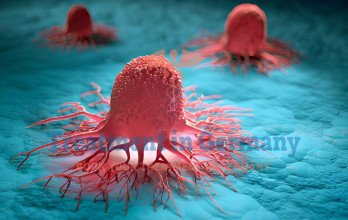
Actinium-225 PRRT combines a radioactive isotope with a molecule designed to target neuroendocrine tumor cells. Ac-225 releases alpha particles as it decays. In Ac-225 DOTATATE, the isotope is attached to DOTATATE, which binds to somatostatin receptor–expressing NET cells. This delivers radiation directly to receptor-positive tumors [1].

Lutetium-177 DOTATATE is an established, approved PRRT for appropriate somatostatin-receptor-positive gastroenteropancreatic NETs. Ac-225 DOTATATE uses the same targeting principle but delivers alpha rather than beta radiation. It is being studied mainly in patients whose tumors remain receptor-positive after Lutetium-177 stops working. Evidence remains limited, so Ac-225 PRRT is used selectively rather than routinely [2].
What Are Neuroendocrine Tumors (NETs)?
Neuroendocrine tumours arise from neuroendocrine cells, found in many organs, which share features of both nerve and hormone-producing cells. They behave very differently from one patient to another: some well-differentiated NETs grow slowly over many years, whereas others are more aggressive and can progress rapidly, depending on factors such as tumor differentiation, grade, primary site, stage, and molecular and biological characteristics [7].

Where Do Neuroendocrine Tumors Develop?
NETs are named after the site where they begin, and that site shapes both symptoms and treatment.
Common primary locations include:
- The pancreas, described as pancreatic NETs.
- The small bowel, particularly the ileum and duodenum.
- The stomach, appendix, colon and rectum.
- The lungs and bronchi, sometimes called pulmonary carcinoids.
- Paraganglia and adrenal glands, giving rise to paragangliomas and phaeochromocytomas these are distinct neuroendocrine neoplasms with their own classification and clinical management considerations.
- An unknown primary, where the tumour is found only after spreading.
For NETs of the digestive system and pancreas, grade describes how quickly tumor cells are multiplying. The Ki-67 index is generally below 3% in grade 1, 3–20% in grade 2 and above 20% in grade 3; tumor grade also incorporates mitotic activity, and when the two measures are discordant, the higher grade is generally assigned. Other NETs may use different grading systems. Receptor expression is assessed separately with imaging.
Metastatic disease means the tumor has spread beyond where it started, often to the liver, lymph nodes or bone. Treatment usually focuses on controlling tumor growth and symptoms, although surgery or other local treatments may still help selected patients.
How Does Actinium-225 PRRT Work?
The treatment works because of a feature of the tumour itself. NET cells carry large numbers of somatostatin receptors on their surface, rather like docking points. DOTATATE is a man-made molecule shaped to fit those docking points, and once attached it is pulled inside the cell along with the radiation it carries. Healthy tissue has far fewer of these receptors, so the radiation gathers where the tumour is although normal organs, including the kidneys and other tissues—also receive radiation.
What makes Ac-225 different from Lutetium-177 is the type of radiation it releases:
- High energy in a small area: Alpha particles release concentrated energy over a very short distance
- Short range: They usually travel only a few cell widths through tissue
- Focused damage: This allows much of their energy to be delivered close to the targeted tumor cells.
Alpha radiation can cause severe DNA damage that tumor cells find difficult to repair [1]. Because it travels only a very short distance, enough receptor expression is needed for the treatment to reach tumor sites effectively.
Why Is Actinium-225 Being Considered for Advanced Neuro
If the disease progresses after Lutetium-177 PRRT, Actinium-225 PRRT (Ac-225 PRRT) may be considered for selected patients whose tumours continue to express somatostatin receptors. Other options may include targeted medicines, chemotherapy, liver-directed treatment, clinical trials or, in selected cases, repeat Lutetium-177 PRRT. The choice depends on tumour type, disease progression, previous treatments and organ function [1] [6].
Is Actinium-225 an Option After Lutetium-177 PRRT?
For some patients, yes. This is the setting in which most published experience sits. Among 89 patients in the pooled analysis who had received prior Lutetium-177 PRRT, the disease response rate after Ac-225 DOTATATE was 51% and the disease control rate 90%. Responses have also been seen in paraganglioma that had stopped responding to Lutetium-177 [1] [4].
Whether it can be considered in an individual case turns on several factors:
- Somatostatin receptor expression: Uptake must still be clearly present across the disease. Progression with loss of receptor expression points away from receptor-targeted treatment altogether.
- Pattern of progression: Slow regrowth in receptor-positive lesions differs from rapid progression in receptor-negative disease.
- Previous treatment: The total radiation already given, and any chemotherapy that has affected the bone marrow’s ability to make new blood cells, both limit what can safely be added.
- Organ function: Kidney, liver and bone marrow function must be adequate.
- General condition: Everyday fitness levels, and whether a patient is well enough for treatment and for travelling.
Actinium-225 vs. Lutetium-177 PRRT for Neuroendocrine Tumors
Both approaches use the same targeting peptide and the same receptor. The difference lies in the isotope attached to it, which changes the physics of the radiation delivered and the clinical position each treatment occupies [1] [2].

Comparison of beta and alpha PRRT. Alpha radiation behaves differently from beta radiation, but that difference alone does not prove it works better for patients.
Who May Be a Candidate for Actinium-225 PRRT?
Eligibility is decided individually. Doctors consider receptor expression, previous treatments, kidney, liver and bone marrow function, overall health and whether another treatment may be more suitable.
Why Somatostatin Receptor Imaging Is Important Before Actinium-225 PRRT
SSTR PET/CT shows whether tumors have enough somatostatin receptors for PRRT to target them. Published Ac-225 studies have generally selected patients with strong receptor uptake. The scan also shows whether different tumors take up the tracer evenly and it can also demonstrate heterogeneity in receptor expression, showing that some tumor sites may have substantially less uptake than others. Tumors with little or no uptake may be less likely to respond. FDG PET/CT may also be used when doctors suspect more aggressive disease [1].
Recent scans matter, because receptor uptake can change over the course of an illness.
Actinium-225 PRRT in Germany: Treatment Process

In Germany, Ac-225 PRRT is given in specialist nuclear medicine facilities under radiation-protection requirements. The exact treatment process and length of hospital stay can differ between centers.
Blood counts and kidney and liver function are checked before treatment. Ac-225 dosing is not yet standardized, and published studies have used different protocols. Patients may also receive an amino acid infusion to help protect the kidneys and are monitored before discharge [1].
How Many Actinium-225 PRRT Cycles Are Needed?
There is no fixed number. Actinium-225 PRRT cycles in published series have ranged from a single administration to ten, with median totals of three to four, and one early series saw meaningful responses after only one or two [1] [5].
Further cycles depend on how well the treatment is working and tolerated. Treatment may continue while helping, pause if side effects develop or stop if the disease progresses.
How Is Treatment Response Monitored After Actinium-225 PRRT?
Response is assessed using scans, blood tests and symptoms. CT or MRI shows whether tumors are shrinking, stable or growing, often using standard RECIST measurements [1]. Blood tests monitor blood counts and organ function, while symptoms help show whether treatment is benefiting the patient. SSTR PET/CT may also be repeated when needed.
Results are described as the tumour shrinking, staying the same, or growing. In advanced NETs, stable disease can be a positive result because it means the tumors have stopped growing. Growth, particularly where new tumours no longer take up the tracer, usually means changing approach.
Side Effects and Risks of Actinium-225 PRRT

Early studies suggest that most reported Actinium-225 PRRT side effects have been manageable, but the studies are small and long-term safety is still being studied.
Short-term effects, Nausea, vomiting, diarrhea and fatigue can occur during or after treatment. Some stomach-related symptoms may be caused by the protective amino acid infusion. Blood counts, Blood-related side effects were uncommon overall. Some patients developed anemia or low white-cell counts, and one had a severe fall in platelets. Risk may be higher after extensive previous treatment or when disease affects the bone marrow. Kidneys, Mild-to-moderate kidney effects were reported in two patients, with no severe kidney toxicity in the pooled studies. Kidney function is monitored closely during treatment. Liver, No treatment-related liver toxicity was reported in the pooled studies, although liver function is routinely monitored. Other risks, Hormone symptoms can flare briefly as tumour cells break down, and one patient developed an underactive thyroid after treatment [1].
Longer-term effects on the bone marrow and kidneys remain uncertain, so regular follow-up is important.
Actinium-225 PRRT for International Patients
International patients are often assessed remotely before traveling. This can help determine whether an in-person assessment is worthwhile before travel is arranged.
Practical planning usually involves:
- Arranging translation of key documents and checking whether an interpreter is available.
- Allowing several weeks before any treatment date, as record review, the specialist meeting and ordering the isotope all take time.
- Booking travel and accommodation only once the centre confirms a date, and planning around a hospital stay and follow-up scans rather than one appointment.
Follow-up is worth sorting out before travelling rather than after. Care between cycles, the German discharge letter and any action on blood results normally fall to the patient’s own oncologist, and agreeing this in advance avoids gaps after the return home.
How to Apply for Actinium-225 Treatment in Germany
The process usually starts with a written enquiry to a centre’s international patient office, giving the diagnosis and noting that the disease has grown after Lutetium-177 PRRT.
- Contact Team TIG: Contact TIG GmbH (Treatment in Germany) with a summary of the case, including previous Lutetium-177 PRRT and evidence that the disease has grown.
- Submission of medical records: Histopathology with grade and Ki-67, treatment history with dates, and recent blood counts and organ function tests.
- Imaging: Recent SSTR PET/CT and CT or MRI scans, including the original images and written reports.
- Specialist assessment: Nuclear medicine and oncology review the material, usually in a multidisciplinary tumour board, and decide whether treatment or further evaluation is appropriate.
- Outcome of the review: The centre confirms whether an in-person assessment is offered, outlines the proposed approach and provides a cost estimate and possible dates.
Centres differ in how they run this and how long review takes, so the steps above are a general guide.
Can Patients from the USA Receive Actinium-225 Treatment in Germany?
Patients from the United States can be assessed for Ac-225 treatment at specialist centres in Germany. Treatment may be possible depending on the individual medical situation, the centre’s eligibility criteria, treatment capacity and Ac-225 availability. A preliminary medical review can help patients understand their options before making travel arrangements.
As Ac-225 availability is limited worldwide, patients should confirm treatment availability and possible dates with the centre in advance.
Cost of Actinium-225 PRRT in Germany
The cost of Actinium-225 PRRT in Germany is around €22,000 per treatment cycle. The final cost may vary depending on the treatment centre and individual treatment plan.
The final cost may depend on:
- the number of treatment cycles.
- scans and laboratory tests.
- hospital treatment and monitoring.
- Ac-225 supply costs; an.
- follow-up imaging and consultations.
At University Hospital Homburg (Universitätsklinikum des Saarlandes), the nuclear medicine department is led by Prof. Samer Ezziddin, whose published work includes peptide receptor radionuclide therapy for neuroendocrine tumours.
References
This article is for information only and does not replace advice from a treating oncologist or nuclear medicine physician. Suitability for Actinium-225 PRRT must be assessed individually.
Why Patients Worldwide Prefer Our Medical Services in Germany – Key Benefits Explained











.webp)
 (1).webp)

.webp)

.jpg)

 (1).webp)
.jpg)