

Pancreatic cancer survival statistics describe groups rather than individuals. This article explains five-year survival rates and how they differ by stage, the difference between median survival, average survival and life expectancy, and the disease, tumour, patient and treatment factors that shape prognosis. It also covers survival after surgery, the effect of recurrence, remission versus cure, and how an individual prognosis is reassessed over the course of treatment.
Pancreatic Cancer Survival, Life Expectancy and Prognosis
Survival statistics describe what happened to large groups of people diagnosed years ago. They provide useful context, but they cannot predict how one person’s disease will behave. Survival after pancreatic cancer treatment can vary by stage, tumour characteristics, overall health and treatment response, so an individual prognosis may change as new information becomes available.
Pancreatic Cancer Survival Rates and What They Mean
The figure quoted most often is the five-year relative survival rate. In a 2025 analysis of SEER 17 data, the five-year relative survival rate was 12% for pancreatic cancer overall among patients diagnosed through 2015, compared with 6% for patients diagnosed in 2004. The improvement was uneven: localized disease rose from 24% to 46%, while distant disease increased only from 2% to 3% [1].

Several measures circulate here, and they answer different questions:
- Five-year relative survival rate: the survival of people with pancreatic cancer five years after diagnosis relative to the expected survival of comparable people in the general population, typically matched for factors such as age and sex.
- Median survival: the point at which half of a group has died and half is still living.
- Individual Survival time: how long one particular patient actually lives after diagnosis.
- Life expectancy: an estimate of remaining lifespan, inferred from group data rather than measured directly
Two limitations apply to all of them:
- They come from people diagnosed years earlier, so they reflect the imaging, chemotherapy and surgery of that period rather than what is available now
- They average across thousands of patients whose tumours and general health differed enormously Neither property allows a number to be applied to one person.
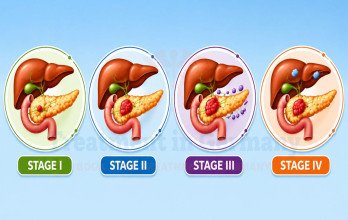
Pancreatic Cancer Survival Rates by Stage
How far the cancer has spread when it is diagnosed is one of the strongest factors influencing those figures. The registry data are reported by extent of disease rather than AJCC stage number, so these categories should not be treated as direct equivalents to AJCC stages.

SEER 17 registry data for patients diagnosed in 2015. Source: Rahib et al. [1].
Outcomes generally worsen as disease becomes more extensive, while treatment options, including potentially curative surgery, become more limited. Stage is a category rather than a prediction, and results vary widely within each group.
Survival in Stage 1 and Stage 2 Pancreatic Cancer
These stages cover disease confined to the pancreas or extending only into nearby tissue and regional nodes, and they produce the most favourable published figures. These groups generally have more treatment options and better survival than locally advanced or metastatic disease, but outcomes vary substantially within each stage. Two features separate patients within the band: whether the tumour can be removed completely, and whether nodes contain cancer, since node-positive disease carries a worse outlook at the same stage. Outcomes still differ after a successful operation, because pathology often finds features imaging could not show.
Survival in Stage 3 Pancreatic Cancer
Stage 3 can include locally advanced disease in which the tumour involves major nearby blood vessels without distant metastases. Survival generally falls between earlier-stage and metastatic disease. In a Dutch multicentre cohort treated with FOLFIRINOX, median overall survival was 12.7 months, with disease control in 77.2%. Treatment response is an important part of reassessment because a sustained response may lead doctors to reconsider whether surgery is feasible [2].
Survival in Stage 4 Pancreatic Cancer
Once the cancer reaches distant organs the reported figures are the lowest of any group, at 3% five-year relative survival. In the same cohort, median overall survival among metastatic patients was 8.1 months, with disease control in 51.4% against 77.2% in locally advanced disease. Burden accounts for much of the range: limited spread to one organ is a different position from extensive involvement of several, yet both sit inside the same statistic. A median is the midpoint of a distribution, not a personal life expectancy [1] [2].
Pancreatic Cancer Life Expectancy and Survival Time

Life expectancy here means an estimate of how long someone is likely to live given what is currently known about their disease. No single figure applies to everyone, because the inputs differ in every case: extent of disease, tumour biology, general health, and how the cancer behaves under treatment. Disease extent sets the broad range, while treatment response can change the outlook. A tumour that stays controlled for months implies a different trajectory from one that progresses during first-line treatment, even at the same starting stage.
Median Survival and Average Survival
Median survival is the time by which half of a group has died. It is preferred in oncology because it is not distorted by the few patients who live far longer than the rest. Average, or mean, survival divides total survival time by the number of patients, which lets a handful of long survivors pull the figure upward. Both differ from five-year survival, a proportion rather than a duration.
Factors That Influence Pancreatic Cancer Prognosis

Patients with the same stage and similar treatment can still have different outcomes because staging does not capture every factor that influences prognosis. Prognosis is assembled from four groups of factors, weighed together:
- Disease-related: how far the cancer has spread and how much of it there is
- Tumour-related: grade, differentiation, location and molecular characteristics
- Patient-related: age, general health, nutritional state and other conditions
- Treatment-related: whether surgery was possible, and how the disease responds
These factors need to be considered together. No single pathological or clinical feature reliably determines an individual's prognosis; the overall combination of disease extent, tumour characteristics, patient factors and treatment response is more informative and decisive.
Disease Extent and Lymph Node Involvement
Disease extent works as a gradient rather than a switch: localized disease carries the most favourable outlook, regional disease involving adjacent structures or nearby nodes sits in the middle, and distant metastases fall into the group with the lowest figures. Lymph node involvement is prognostically significant in its own right and is among the factors consistently associated with long-term survival after resection [1] [3].
Tumour Characteristics and Cancer Biology
Beyond how far the cancer has travelled, what it is made of matters:
- Grade and differentiation: poorly differentiated tumours behave more aggressively and carry a worse outlook at equivalent stage.
- Location: head-of-pancreas tumours often cause jaundice early and bring them to clinical attention earlier, while tumours in the body or tail often produce fewer early obstructive symptoms and may therefore present at a more advanced stage.
- Molecular subtype: in the SPACIOUS-2 study of resected patients, 17.6% were basal-like, and these had shorter median overall survival than classical tumours, 11 versus 16 months [4].
- Size: relevant mainly where it determines whether complete removal is achievable.
Molecular subtyping is not routine everywhere, and its prognostic value falls once standard pathology is taken into account [4].
Overall Health and Treatment Response
General condition determines what treatment someone can realistically receive. The elements that matter most are:
- Functional status, usually recorded as performance status, and whether daily activities are preserved.
- Nutritional condition, including significant unintentional weight loss and muscle loss.
- Other medical conditions and organ function, which set practical limits on treatment intensity.
Treatment response can substantially refine prognosis over time. Disease that shrinks or remains stable across successive scans indicates that the cancer is responding to or remaining controlled by treatment. These findings are interpreted together with symptoms, treatment tolerance and the overall clinical picture. The gap in disease control between locally advanced and metastatic patients, 77.2% against 51.4%, tracks the survival difference between them [2].
Survival After Pancreatic Cancer Surgery

Complete surgical removal is an important factor associated with long-term survival in resectable pancreatic cancer. In a meta-analysis of 25 studies covering 27,091 resected patients, the median proportion surviving five years or longer was 18.3%. Long-term survival is therefore achievable after resection, although most patients in the reviewed studies did not reach five years [3].
Factors That Shape Postoperative Survival
The final pathology report provides important information for refining prognosis after surgery. The findings that carry weight include:
- Final pathological stage, which sometimes differs from the clinical stage assigned beforehand.
- Lymph node status, and the proportion of examined nodes containing cancer.
- Margin status, meaning whether cancer cells reach the cut edge of the specimen.
- Tumour grade, and the presence of lymphovascular or perineural invasion.
- Extent of disease actually found at operation, including anything not visible on imaging.
Each is associated with long-term survival, but no single parameter predicts it alone [3].
Long Term Outcomes Following Pancreatic Cancer Surgery
A meaningful minority achieve durable disease control, and five-year survival after resection is now common enough to be studied as an outcome in its own right. Reaching that point does not close the matter: recurrence has been documented well beyond five years [3].
Impact of Pancreatic Cancer Recurrence on Survival

Pancreatic cancer can recur even after apparently complete removal because microscopic disease may remain undetectable at the time of surgery. Recurrence requires the prognosis to be reassessed. In a UK cohort followed after curative resection, median time to recurrence was 8.5 months and median survival after recurrence was 5.8 months [5]. Individual outcomes can vary considerably around these median figures.
Risk of Pancreatic Cancer Returning After Treatment
Several pathological factors are associated with recurrence risk, including:
- Involved lymph nodes, particularly a high ratio of positive to examined nodes.
- A positive or narrowly clear resection margin.
- Higher tumour grade, and lymphovascular or perineural invasion.
- A CA 19-9 level that fails to normalise after surgery.
These describe probability, not certainty. Some patients with several adverse features never recur, and some with none do.
Survival and Prognosis After Recurrence
Once recurrence is confirmed, several things are weighed together:
- The interval since surgery, since a long gap generally reflects less aggressive biology than a return within months.
- The site: loco-regional recurrence alone was associated with longer disease-free survival than simultaneous loco-regional and distant recurrence, at a median of 13.6 versus 7.5 months [5].
- The extent of the recurrent disease and the treatment already received.
- Current general condition, and the response to whatever comes next.
Recurrent disease has no single survival estimate, and any figure quoted at that point is provisional.
Remission and Long-Term Survival in Pancreatic Cancer

Remission and cure are not interchangeable terms, and the distinction matters when interpreting good news after treatment.
Remission After Pancreatic Cancer Treatment
Three terms get used loosely but mean different things:
- Partial response: measurable shrinkage of the tumour on imaging.
- Complete response: no visible disease on imaging, which is uncommon in pancreatic cancer.
- No evidence of disease: usually said after surgery, meaning nothing is detectable rather than that nothing remains.
Cure means that the cancer is no longer detectable and is not expected to return, although recurrence can still occur after apparently successful treatment. This is why follow-up continues even when scans show no detectable disease.
Long Term Survival and Follow Up
Long-term survival does occur, and the proportion of resected patients reaching five years is no longer negligible. Follow-up continues with periodic imaging, clinical assessment and tumour markers at lengthening intervals. Each stretch without recurrence improves the estimate, while any new finding prompts reassessment. Long-term care also covers the consequences of treatment itself, including enzyme replacement and diabetes management [3].
Individual Pancreatic Cancer Prognosis and Survival
Population statistics provide important context, but they cannot determine an individual's prognosis. They combine patients with different tumour characteristics, disease extent, health status and treatments.
Factors That Shape an Individual Prognosis
An individual prognosis depends on several factors, including disease extent, pathology findings, tumour characteristics, lymph node status, general health, treatment tolerance, treatment response, and whether the cancer has progressed or returned. Their importance varies by situation. For example, lymph node status is particularly relevant after surgery, while treatment response becomes more important in metastatic disease. When a second opinion is sought, reviewing the original imaging and pathology at a specialist pancreatic centre in Germany can provide a more complete assessment, particularly because factors such as margin status and lymph node involvement depend on the surgical and pathology findings.
How Prognosis Changes During Treatment
Prognosis is an estimate that can change as new clinical information becomes available. It is revised:
- When final pathology arrives after surgery.
- At each response assessment during treatment.
- If the disease progresses or returns.
- As additional follow-up information becomes available.
In the Dutch cohort, the probability of surviving two years rose from 14% to 26% among locally advanced patients still alive a year after finishing chemotherapy, and from 10% to 29% among metastatic patients [2].

For international patients seeking treatment, TIG GmbH can help coordinate access to specialist pancreatic cancer centres in Germany, where prognosis can be reassessed as treatment and follow-up information become available.
References
Why Patients Worldwide Prefer Our Medical Services in Germany – Key Benefits Explained




















.webp)
 (1).webp)
.webp)

.jpg)

 (1).webp)
.jpg)