
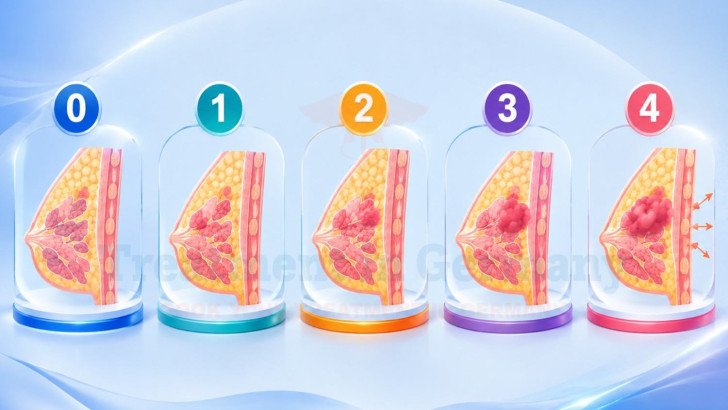
Breast cancer staging describes how far the disease has spread, while prognosis depends on several factors beyond stage alone. This guide explains breast cancer stages 0 to 4, including tumor size, lymph-node involvement, and distant metastasis, as well as tumor grade, hormone receptor and HER2 status, survival rates, breast cancer subtypes, and the factors that can influence individual outcomes.
Breast Cancer Stages and Prognosis: Survival Rates by Stage
Breast cancer stage describes the extent of the disease, including the size and local extent of the primary tumor, whether regional lymph nodes are involved, and whether the cancer has spread to distant parts of the body [1]. Prognosis is a broader concept. Doctors also consider tumor biology, including hormone receptor and HER2 status, tumor grade, and treatment response, when estimating prognosis. Stage provides an important starting point for estimating prognosis. Tumor biology and response to therapy significantly influence an individual's overall prognosis.
Breast Cancer Staging, Prognosis and Survival

Breast cancer is assigned a stage from 0 to IV based on the extent of disease and, for prognostic staging, additional tumor characteristics such as grade and biomarker status [1].
- Stage 0: non-invasive breast cancer, most commonly ductal carcinoma in situ (DCIS), where abnormal cells remain confined to their original location.
- Stage I and II: early-stage disease, ranging from smaller tumors without regional nodal involvement to tumors with limited regional lymph-node involvement.
- Stage III: locally advanced disease with more extensive tissue or nodal involvement but without distant metastasis.
- Stage IV: metastatic disease that has spread beyond the breast and regional lymph nodes to distant sites.
For population reporting purposes, registries such as SEER group breast cancer cases into localized, regional, and distant categories rather than reporting every AJCC stage separately [6]. Stage and tumor grade are related but not the same. Grade describes how abnormal cancer cells look under a microscope, while stage describes how far the disease has spread in the body. This is why tumor biology, treatment response, overall health, and other clinical factors, in addition to anatomical and prognostic stage, can all shape an individual's outlook [4].
Breast Cancer Staging Factors

Oncology teams assess tumor characteristics, lymph-node findings, distant spread, grade, and relevant biomarkers to determine the cancer's stage and better understand its prognosis.
Tumor Size and Local Tumor Extent
The T category reflects the size of the primary tumor and whether it has directly invaded adjacent structures, such as the chest wall or skin [3].
- T1: tumor 2 cm or smaller, with further subdivisions based on exact size.
- T2: tumor larger than 2 cm but not more than 5 cm.
- T3: tumor larger than 5 cm.
- T4: a tumor of any size with direct extension to the chest wall and/or specific skin involvement such as ulceration, ipsilateral satellite skin nodules, and/or edema (including peau d'orange), while T4d denotes inflammatory breast cancer.
Inflammatory breast cancer (T4d) presents with rapid onset of breast swelling, redness, warmth, and skin dimpling rather than a typical discrete lump. Because these symptoms can easily be mistaken for a common bacterial infection (mastitis), any sudden breast redness, warmth, or skin changes require immediate evaluation by a specialist, especially if symptoms do not resolve quickly with antibiotics.
Tumor size is only one part of the staging assessment. A small tumor with significant lymph node involvement can be staged higher than a larger tumor with no nodal spread and, when prognostic staging is used, tumor grade and biomarker status can also affect the final stage group.
Regional Lymph Node Involvement
Regional lymph nodes, mainly those under the arm, above the collarbone, and near the breastbone, are assessed for cancer cells [3]. The number and location of affected nodes make up the N category, ranging from N0 (no nodal spread) to N3 (extensive nodal involvement). AJCC breast staging distinguishes isolated tumor cells, micrometastases, and macrometastatic nodal disease.
Nodal involvement can raise the overall stage substantially, even when the primary tumor is small. Regional lymph node spread is distinct from distant metastasis, meaning cancer has spread to sites beyond the regional lymph nodes.
Distant Metastasis and Stage 4 Classification
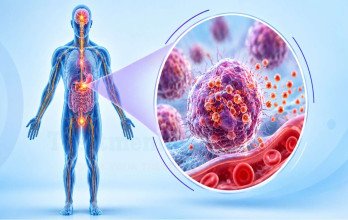
Distant metastasis means that cancer has spread beyond the breast and regional lymph nodes to distant sites. Common sites include:
- Bones.
- Liver.
- Lungs.
- Brain.
Any confirmed distant metastasis, regardless of tumor size or nodal status, classifies the cancer as Stage 4 [1]. Stage III disease has not spread to distant sites, although it may involve the breast, chest wall, skin, and regional lymph nodes. Confirmed distant metastasis places breast cancer in Stage IV.
Clinical, Pathological and Prognostic Staging
Clinical staging is assigned before treatment, based on physical examination, imaging, and biopsy findings obtained through breast cancer diagnosis and screening [1]. Pathological prognostic staging is performed after surgery when surgery is the initial treatment, and incorporates clinical information together with findings from the tumor and lymph nodes removed during the operation. When appropriate, it can provide additional information beyond clinical staging.
The AJCC 8th edition introduced prognostic stage groups that incorporate TNM findings together with tumor grade and biomarker status, allowing some tumors with the same anatomical extent to receive different prognostic stage groups [4]. In Germany, breast cancer diagnosis, treatment and follow-up are guided by the national S3 guideline developed through the Leitlinienprogramm Onkologie. The current version is Version 5.1 [2].
Breast Cancer Stages 0 to 4

The overview below shows how disease extent progresses from non-invasive breast cancer to regional and metastatic disease.
Stage 0 Breast Cancer
Stage 0 breast cancer most commonly refers to ductal carcinoma in situ (DCIS), a non-invasive condition where abnormal cells remain confined within the breast ducts and have not invaded surrounding tissue. Unlike invasive breast cancer, DCIS has not grown beyond the duct lining and has not spread to lymph nodes or other tissue. It is non-invasive and does not represent distant metastatic disease.

The outlook for Stage 0 breast cancer is generally excellent because the abnormal cells have not invaded surrounding breast tissue or spread to lymph nodes or distant organs. Some DCIS can progress to invasive breast cancer if left untreated, although the risk varies among individual cases; management is therefore based on the patient's pathology, imaging findings, risk factors, and clinical circumstances [1].
Stage 1 and Stage 2 Breast Cancer
Stages I and II are considered early-stage breast cancers because they are generally limited to the breast and regional lymph nodes rather than distant organs [3].
- Stage I: Cancer is generally confined to the breast or involves only very limited regional lymph-node disease. Under the AJCC prognostic staging system, Stages IA and IB are defined by integrating primary tumor size and regional lymph node involvement with tumor grade and biomarker status [4].
- Stage II: Cancer remains in the breast and/or nearby lymph nodes but has greater local or regional involvement than Stage I. Stage IIA and IIB are determined using TNM findings together with tumor grade and biomarker status when prognostic staging is used [1].

Individual prognosis at these stages depends on tumor biology, treatment response, and overall health, not on stage alone.
Stage 3 Breast Cancer
Stage III, also called locally advanced breast cancer, involves more extensive regional disease than Stage II, which may include significant lymph-node involvement or extension of the tumor to the chest wall or skin. The exact stage group (IIIA, IIIB, or IIIC) depends on TNM findings under anatomical staging; prognostic stage grouping can additionally incorporate tumor grade and ER, PR, and HER2 status [1].

Prognosis for Stage III breast cancer is generally less favorable than for earlier-stage disease, though it still varies considerably depending on tumor biology, grade, biomarker status, and how the cancer responds to treatment [9].
Stage 4 Breast Cancer
Stage 4, or metastatic breast cancer, means the disease has spread beyond the breast and regional lymph nodes to distant sites, most commonly the bones, liver, lungs, or brain. Treatment of metastatic disease is discussed in Stage 4 breast cancer treatment [1].

Distant metastasis is what places breast cancer in Stage 4, regardless of the original tumor's size. Outcomes in metastatic breast cancer vary substantially between individuals. Tumor biology, the sites and extent of metastatic disease, response to treatment, overall health, and other clinical factors can all influence outcomes [9].
Breast Cancer Survival Rates by Stage
Five-year relative survival compares people with breast cancer to similar people in the general population who don't have the disease; it doesn't predict any individual patient's outcome. Rather than reporting survival by each AJCC prognostic stage group, SEER (a large national cancer registry) publishes survival using combined summary-stage categories: localized, regional, distant, and unknown [5] [6].
SEER groups breast cancer cases into four summary-stage categories. About 64% are diagnosed while the disease is localized to the breast, with a 5-year relative survival of 100.0%. Around 27% are regional cases involving nearby lymph nodes or tissues, with 87.5% survival. Approximately 6% are diagnosed at the distant stage, where cancer has spread to other organs, with 33.8% survival. About 2% have an unknown or unstaged status, with 70.6% survival. Across all stages combined, the 5-year relative survival is 91.9%.

About two-thirds of female breast cancers in the SEER dataset are diagnosed at the localized stage, where 5-year relative survival is reported at 100.0%. A relative survival rate of 100.0% is a population-level comparison, meaning that women diagnosed with localized breast cancer are, on average, just as likely to live for 5 years after diagnosis as similar women in the general population who do not have breast cancer. It measures comparative disease impact against a cancer-free peer group; it is a population average and not a guarantee that zero disease recurrence occurs in an individual patient.
It's worth distinguishing relative survival from overall survival. Overall survival measures the proportion of patients alive at a given time, regardless of cause of death, while relative survival compares observed survival with that of a comparable general population [7].
These figures are population averages drawn from patients diagnosed several years earlier, so they can lag behind current treatment advances and cannot predict what will happen to any one patient. They also don't map directly onto AJCC stages IA through IIIC, since prognostic staging incorporates tumor grade and biomarker status factors that can shift survival considerably within the same anatomical stage. Individual prognosis depends on stage together with tumor biology, grade, and treatment response [1].
Factors That Affect Breast Cancer Prognosis

Several factors, beyond stage alone, shape an individual's prognosis [9].
- Cancer stage at diagnosis.
- Tumor size.
- Lymph node involvement.
- Tumor grade.
- Estrogen receptor (ER) and progesterone receptor (PR) status.
- HER2 status.
- Molecular subtype.
- Age and overall health.
- Response to treatment.
- Recurrence or disease progression.
- Presence and location of metastatic disease.
These factors do not affect every patient in the same way, so doctors consider them together when discussing prognosis. A hormone receptor-positive tumor, for example, can have a different prognosis from a triple-negative tumor even at an identical anatomical stage.
Breast Cancer Prognosis by Subtype

Breast cancer is not a single disease. Breast cancer types and subtypes can carry different prognoses even among patients with the same anatomical stage [8].
- Hormone receptor-positive breast cancer: often associated with more favorable population-level outcomes than hormone receptor-negative disease, although prognosis varies with stage, grade, HER2 status, and other tumor and patient factors.
- HER2-positive breast cancer: characterized by increased HER2 signaling; outcomes have improved substantially with advances in HER2-directed treatment.
- Triple-negative breast cancer: lacks ER, PR, and HER2 expression; prognosis varies based on stage, tumor characteristics, and response to treatment.
- Invasive ductal carcinoma: the most common histological subtype
- Invasive lobular carcinoma: a less common subtype with a distinct growth pattern
- Inflammatory breast cancer: a rare, aggressive clinical presentation characterized by rapid development of breast swelling, redness, and skin changes; it is classified as T4d in the TNM system.
Among patients with localized disease, five-year relative survival exceeds 92% regardless of subtype. The gap widens considerably at the distant stage, where hormone receptor-negative, HER2-negative (triple-negative) disease has substantially lower survival in current population-level data than hormone receptor-positive disease [8]. Inflammatory breast cancer is classified as T4d in the TNM system because of its characteristic clinical skin changes, and it is generally associated with a more guarded prognosis than other presentations at a similar stage [10].
Tumor biology, not just anatomical extent, drives many of these differences, which is one reason oncologists always interpret stage alongside receptor and HER2 status rather than in isolation. Knowing the stage and biological features of the cancer can help you and your medical team understand the likely course of the disease and discuss prognosis. For individuals considering breast cancer treatment in Germany, specialized breast centers and expert oncologists are accessible through TIG GmbH (treatment in Germany).
References
[1] National Cancer Institute Stages of Breast Cancer
[2] AWMF S3-Leitlinie Früherkennung, Diagnostik, Therapie und Nachsorge des Mammakarzinoms, Version 5.1
[4] ASCO Educational Book Incorporating Biology Into Breast Cancer Staging (AJCC 8th Edition)
[5] American Cancer Society Survival Rates for Breast Cancer
[6] SEER (National Cancer Institute) Cancer Stat Facts: Female Breast Cancer
[7] CDC U.S. Cancer Statistics: Female Breast Cancer Stat Bite
[8] SEER (National Cancer Institute) Cancer Stat Facts: Female Breast Cancer Subtypes
[9] NCCN Guidelines for Patients Invasive Breast Cancer
[10] NCCN Guidelines for Patients Inflammatory Breast Cancer
Why Patients Worldwide Prefer Our Medical Services in Germany – Key Benefits Explained

















.webp)
 (1).webp)

.webp)


.jpg)

 (1).webp)

.jpg)